Description
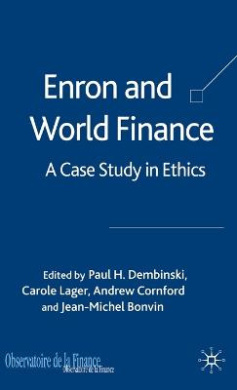
Four years after the debacle, the term ‘Enron’ has earned its place in the everyday vocabulary of business ethics. Hardly anyone understands the business intricacies of what really happened with the sophisticated energy conglomerate. Even fewer are those able to envision, beyond the business case, the ethical questions and dilemmas facing actors at any one stage of the drama. Using the collapse of Enron as a case study, this book not only shows how and where ethics came into play, but also draws lessons and discusses possible remedies that may prevent the whole financial system from falling apart as a result of either excessive greed or over-regulation. HENRI-CLAUDE DE BETTIGNIES Chair in Leadership and Responsibility and Professor of Asian Business and Comparative Management at INSEAD, France HANS J. BLOMMESTEIN Head of Capital Markets Programme at the OECD, and Professor of Finance, Tilburg University, The Netherlands HOHN R. BOATRIGHT Professor of Business Ethics, Graduate School of Business, Loyola University, Chicago, USA JOHN DOBSON Researcher, California Polytechnic State University, USA EDWARD DOMMEN President of the Scientific Committee of the Geneva International Academic Network, Switzerland ROBERT G. KENNEDY Professor, Departments of Management and Catholic Studies’ University of St Thomas, USA BETH KRASNA Independent Board Member, Vaud Cantonal Bank, Switzerland; Federal Institutes of Technology; Raymond Weil South Africa FRANOIS-MARIE MONNET Formerly Chair of the Swiss Bond Commission of the European Federation of Financial Analysts’ Societies; member of the Swiss Stock Exchange Bond Index Commission; Board of Directors of the SICAV, created to respond to the needs of institutional investors FRANK PARTNOY Professor of Law, University of San Diego, USA ETIENNE PERROT Economist specializing in economic rent and corruption CATHERINE SAUVIAT Senior Economist, Institut de Recherches Economiques et Sociales, France DOMINGO SUGRANYES Member of the Executive Board of MAPFRE, an international Spanish-based mutual insurance group ANTHONY TRAVIS Partner, PricewaterhouseCoopers, Geneva, Switzerland List of Tables and Boxes Acknowldgements Notes onn the Contributors List of Abbreviations Overview of the Book; A.Cornford PART 1: ENRON: ORIGINS, CHARACTER AND FAILURE Enron and Internationally Agreed Principles for Corporate Governance and the Finance Sector; A.Cornford A Revisionist View of Enron and the Sudden Death of ‘May’; F.Partnoy Who Is Who in the World of Financial Swaps and Special Purpose Entities?; F-M.Monnet PART 2: ETHICS IN THOUGHT AND ACTION An Ethical Diagnosis of the Enron Affair; E.Perrot Anonymity: Is a Norm as Good as a Name?; E.Dommen Spaces for Business Ethics; D.Sugranyes PART 3: CORPORATE GOVERNANCE AND AUDITING The Demise of Andersen: Corporate Governance Failure; C.Sauviat Enron et al and Implications for the Auditing Profession; A.Travis Enron Revisited: What Is a Board Member to Do?; B.Krasna How to Restore Trust in Financial Markets?; H.J.Blommestein PART 4: CORPORATE CULTURE AND ETHICS Enron: The Collapse of Corporate Culture; J.Dobson Ethics, Courage and Discipline: The Lessons of Enron; R.G.Kennedy Developing Leadership and Responsibility: No Alternative for Business Schools; H-C. de Bettignies Ethics for a Post-Enron America; H.R.Boatright PART 5: CONCLUSION Enron: Visiting the Immersed Part of the Iceberg; P.H.Dembinski & J-M.Bonvin Index